
about us
less waste.
real life.
bare market exists to make reducing waste easier, more affordable + more realistic.
Today, we're a 100% online low-waste shop offering body care, home care + DIY refills, bulk + case-sized food, and everyday products that help you create less waste. Shop online, pick up for free through our pickup network, get Local Delivery across much of the GTA, or have eligible products shipped across Canada.
But bare market didn't start online, and the way we refill today looks very different from the way we started.
That's kind of the point.
it started with a pretty simple question
Why was it so difficult to buy everyday products without all the packaging?
The idea for bare market started while founder Dayna Stein was studying sustainable food systems at UBC in Vancouver, where refill shopping became part of her own routine.
She went on to complete a master's degree focused on sustainability and work as a sustainability consultant before deciding to take the leap and build something of her own.
Dayna began developing bare market in 2017. The first pop-up followed in 2018.
For the next couple of years, we tested the idea at farmers' markets, community spaces, other retailers + events around Toronto.
They weren't just places to sell things. They were market research.
What did people actually refill? What prices worked? What neighbourhoods showed up? What made low-waste shopping easier, and what made it annoying?
From the beginning, the goal was to make lower-waste shopping more physically + financially accessible, not to create something exclusively for people already living a perfectly "zero waste" life.

an early bare market pop-up setup
same goal. different ways of getting there.
The mechanics have changed a lot since 2017. The reason for doing it hasn't.
the shop was a system, not just a store
After dozens of pop-ups, bare market became a 2,800-square-foot shop on Toronto's Danforth in February 2020.
Customers could refill food, body care, home care + DIY products, bring practically any clean container they already owned, borrow one from us, and do most of the process themselves.
But we tried to apply the same thinking behind the products to the space itself.
During the design + construction process, we looked for used fixtures and refurbished equipment before buying new, saved materials from demolition for reuse, and made intentional choices about materials, finishes + how the store would operate.
The closed-loop café was designed as part of that system too, intentionally creating another use for surplus produce, bulk ingredients + food from elsewhere in the shop before it became food waste.
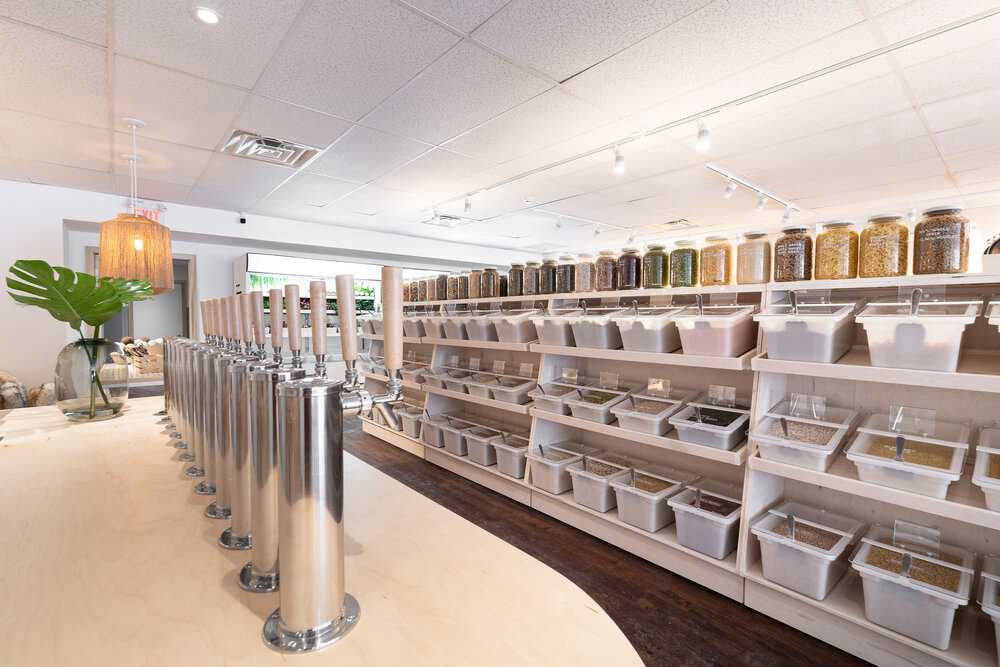
self-serve refill + bulk food inside the Danforth shop
The question wasn't only,
how do we sell something without a disposable package?
It was,
where else can we design waste out of the system?
six weeks later, everything changed
The shop had been open for roughly six weeks when COVID hit Toronto. Although we sold food and were technically allowed to remain open, we shut completely for about three days.
Then we rebuilt the way the business worked.
Thousands of products had to go online almost immediately while we simultaneously invented a safe way for people to collect orders that almost always crossed multiple parts of the store: fresh produce, frozen food, bulk groceries, canned goods, bread + treats, body care, cleaning products, DIY ingredients + more.
The system changed repeatedly as we figured it out.
One version involved roughly four hours of scheduled pickup every morning, divided into 10-minute windows. Five customers could be booked into each 10-minute interval but entered one at a time, collecting orders that almost always spanned multiple parts of the store.
Once the morning pickups finished, we spent the afternoons + evenings organizing and packing the next wave of orders so we could do it all again the following morning.
It was intense, imperfect + built in real time. And it worked.
That period reinforced something we've carried forward ever since: the mission doesn't have to be tied to one particular way of shopping.
Our closed-loop café reopened later that summer. In-person shopping returned. BYOC returned. And over the following years, we kept adapting the model as public-health rules, customer behaviour + what actually worked changed.
want to see how it actually worked?
The physical shop brought a lot of these ideas together in one place: self-serve refill, food, reusable packaging, the café + the systems behind it.
This long-form tour captures that version of bare market before the business changed again.
the store was one version of bare market
We ran the Danforth shop until May 2024.
Closing the storefront didn't mean abandoning refill. It meant figuring out what the next version could look like.
In June 2024, we launched online BYOC alongside a network of pickup hubs.
Customers could drop off their own labelled containers, we filled them, moved them through our fulfillment system + returned them through partner locations.
We kept that model going for more than a year.
It preserved something we loved about refill shopping: using the container you already own.
But transporting, sorting, identifying, filling + tracking hundreds of individual containers across fulfillment, delivery routes + multiple pickup locations was a very different system from filling a jar in front of someone in a store.
Eventually, it stopped being the best way to accomplish what we were trying to do.
So in October 2025, we adapted again.
same objective. different mechanics.
Today, most liquid refills travel in deposit pouches or jars. Use the refill directly or pour it into a container you already own, then return eligible deposit packaging through our return network for reuse.
We don't think sustainability means pretending there's one perfect package.
Glass is durable + highly reusable, but it's also heavy, bulky + breakable. An empty one-litre glass jar can weigh around 480 g. A one-litre plastic refill pouch is closer to 18 g.
That difference matters when products have to travel instead of being poured from a dispenser in a store.
how refills + returnable deposit packaging work today
Pouches aren't impact-free. Neither are jars, cardboard boxes, delivery vehicles or anything else involved in getting products from where they're made to where they're used.
So we keep looking at the whole system + making practical choices that reduce unnecessary material, weight, waste + cost wherever we can.
affordability has always been part of it
Waste reduction only works at scale if people can actually afford to participate.
That has shaped bare market since the pop-up days.
Today, larger refill sizes lower the price per g or mL. Case-sized food reduces portioning + repacking. Our Back to Basics collection focuses specifically on lower-cost everyday refills.
We also reuse an enormous amount of what comes into the business. In almost a decade, we haven't bought new shipping boxes or protective packing materials. We reuse supplier boxes, incoming packing materials + boxes donated by other local businesses instead.
The point isn't to make sustainability look perfect.
It's to make lower-waste systems practical enough to keep using.
local still matters
Around 70% of the brands we carry are Canadian.
Where something is made matters, but it isn't the only question we ask. Ingredients, performance, supplier practices, packaging, price + what happens elsewhere in the supply chain matter too.
Because reducing the bottle you take home is useful.
Reducing waste throughout the system is better.
does it actually add up?
500,000+Since bare market began, our refill + reuse systems have helped divert more than 500,000 single-use containers from landfill.
That number matters because waste is tangible. You can count the shampoo bottles, laundry jugs + cleaning-product containers that didn't need to be replaced.
But waste has always been the entry point into something bigger.
The low-waste build was part of it. The closed-loop café was part of it. So were BYOC, deposit packaging, refill hubs, reusing incoming shipping materials + finding ways to reduce waste elsewhere in the system.
The question has never just been, how do we get rid of this bottle?
It's where else in the system can we avoid creating waste in the first place?

returnable deposit pouches + jars used today
low waste, not zero waste.
bare market has been a pop-up, a market stall, a 2,800-square-foot shop, a closed-loop café, a BYOC store, an online grocery business, a network of refill hubs + now a fully online refill business.
Some versions worked for years. Some made sense for one particular moment. Some eventually stopped being the best way to accomplish what we were trying to do.
We don't think sustainability means finding one perfect solution + refusing to change it.
It means paying attention to what's actually working, being willing to question the system you built + changing it when there's a better way forward.
That's also why we talk about low waste, not zero waste.
Nobody, including us, gets this perfectly right. We'd rather help you make a few changes that stick, refill instead of rebuy, one product at a time, than sell you on an all-or-nothing lifestyle.
bare market has changed shape a lot since 2017.
The goal hasn't.
And if we can make it easier for you to refill the bottle you already own instead of buying another one, that's a pretty good place to start.